Painted Sermons

Vision of Elizabeth

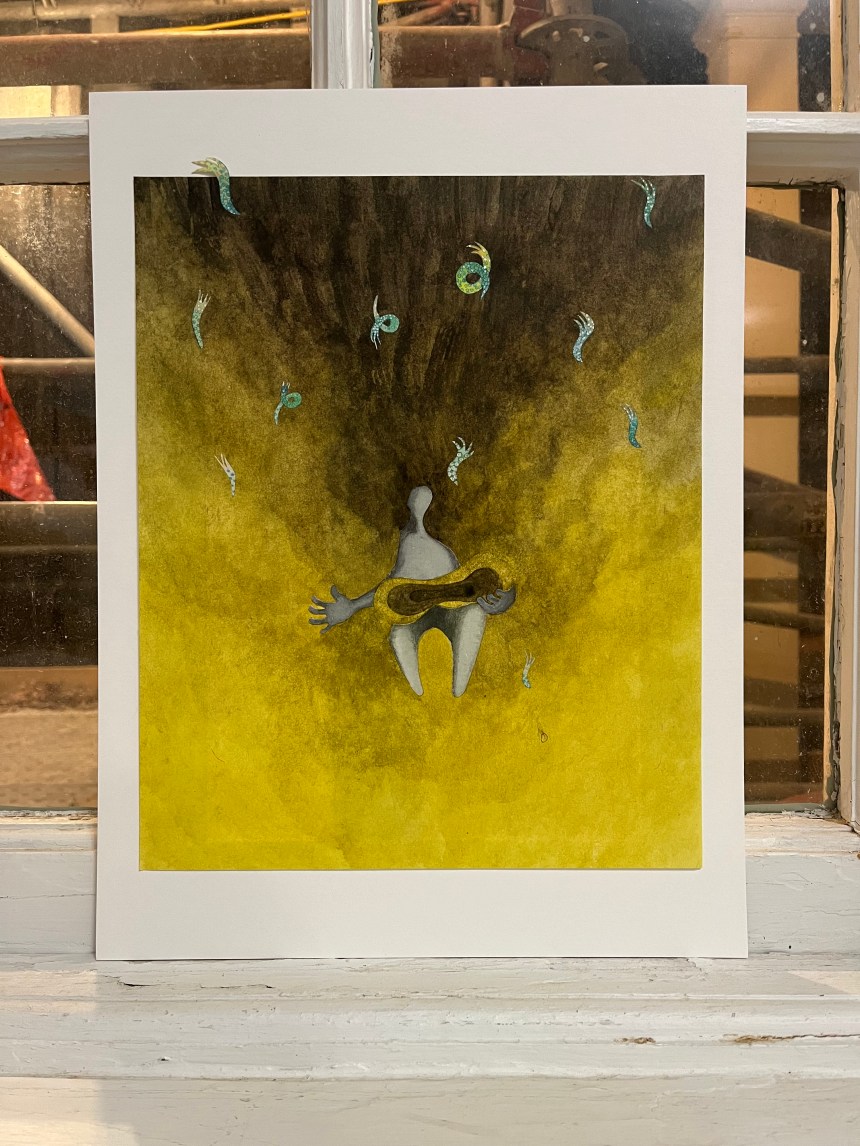
I am experimenting with visual exegesis–painting being the sermon. The accompanying text for enriching the interpretation rather an explaining the picture. I am imagining a kind of visual sermon could be given during a church service, in a combined format of visio-divina and spoken word.

Scripture

Luke 1:39-45 (NRSV):

In those days Mary set out and went with haste to a Judean town in the hill country, where she entered the house of Zechariah and greeted Elizabeth. When Elizabeth heard Mary’s greeting, the child leaped in her womb. And Elizabeth was filled with the Holy Spirit and exclaimed with a loud cry, “Blessed are you among women, and blessed is the fruit of your womb. And why has this happened to me, that the mother of my Lord comes to me? For as soon as I heard the sound of your greeting, the child in my womb leaped for joy. And blessed is she who believed that there would be a fulfillment of what was spoken to her by the Lord.

Accompanying Text 

Today I want to invite you to experience the Advent through the eyes of Elizabeth. 

Elizabeth, whom we know well as a wife of Zechariah, mother of John the Baptist, and relative of Mary, and a priestess. Her poem, a prayer, or a loud cry proclaimed with unrestrained joy upon seeing Mary, becomes adopted by the Catholic church as the Hail Mary Prayer and is still recited every day by Christians all over the world. 

Blessed art thou amongst women
and blessed is the fruit of thy womb, Jesus.

My painting is an attempt to depict what Elizabeth may have been seeing as she was proclaiming these words to Mary. 

When I heard the Hail Mary Prayer for the first time, I was baffled by this word, “fruit of thy womb.” Why did they speak of a baby in such way? 

Luke is using the Hebrew idiom peri bitni–the fruit of my womb–which was used interchangeably with bene bitni–the son of my womb. These expressions simply mean children and were used by both men and women. So when a Hebrew man spoke of children as having come from his womb, he was using this word not literally, but as a figure of speech for his body. 

This phrase, “fruit of body” stretches our imagination and opens up a pathway to see human bodies along with other species that produce fruits, such as an apple tree, a tomato vine, and an autumn olive tree. 

But still, Elizabeth blessing the fruit of Mary’s womb sounds strange to me because it sounds like she is isolating the biological body of Mary as an object to be blessed. This can be read in two ways. First option is to see the role of woman as an incubator for the son, who is more worthy than her. Although it sounds insulting for women of our time, this was how women were viewed in ancient times. Therefore, when a woman’s body couldn’t fulfill this function, she was blamed and was considered unworthy. 

Elizabeth at this time was six-months-pregnant, and this pregnancy would have been considered a miracle given that she was well beyond the typical age of childbearing. We don’t get to hear about her prayer for a child before her conceiving John, but it is not difficult to imagine her numerous prayers of plea for a child. The Old Testament gives us accounts of other women who shared a similar trouble as Elizabeth as in the cases of Sarah, Naomi, Rachel, and Hannah. These women were blamed for childlessness and had to endure social disgrace for not being able to produce or nurture any fruit. 

In this context we can emphasize with Elizabeth’s joy, when she said, “Blessed are you, among women.” It would not be to say that Mary is special only among women, as opposed to the whole humanity, but Elizabeth is acknowledging the particular problems that women had in her time. When we are blessing others, I think it can be replaced with other words that represents hardships present in a specific community. For example, we can say “Blessed are you, among middle schoolers.” “among the immigrants,” “among the refugees,” “among the unemployed,” … and so on. 

Another way of reading womb here is to see it in connection with how the common ancient Near Eastern viewed the earth as a mother’s body and mother’s body as earth. In Psalm 139, we hear the author using mother’s womb and the earth interchangeably.

For it was you who formed my inward parts
you knit me together in my mother’s womb.
I praise you, for I am fearfully and wonderfully made.
Wonderful are your works;
that I know very well.
My frame was not hidden from you,
when I was being made in secret,
intricately woven in the depths of the earth.

Job says in the first chapter in verse 21, 

Naked I came from my mother’s womb, and naked shall I return there; the Lord gave, and the Lord has taken away; blessed be the name of the Lord.

Job cannot mean literally what it says, that Job will return to his human mother’s womb, but what he means is that the dead returns to the womb of Mother Earth.

I think Elizabeth is first seeing Mary as a biological woman whose body has a womb that is bearing a child, and she is rejoicing for her pregnancy as we know it is one of the highest honors woman could have in her time. But also, filled with the Holy Hpirit, she is seeing Mary as the mother of all universe, who is carrying a child, who is to be her Lord, her God. 

And she is unapologetic to proclaim what she sees: 

And why has this happened to me
That the mother of my Lord comes to me

Following this initial proclamation of joy and surprise, Elizabeth offers Mary words of affirmation, as a caring pastor would, acknowledging the praiseworthy deeds and intentions that she sees in Mary.

Blessed is she who believed that there would be a fulfillment of what was spoken to her by the Lord.

My prayer is that we, who are called as ordained ministers, lay leaders, activists, teachers, public theologians, or any other roles that are incubating in our bodies, will be filled with the same Spirit that once filled Elizabeth–that through our words of blessing and affirmation, God’s words will bear fruit on earth. 
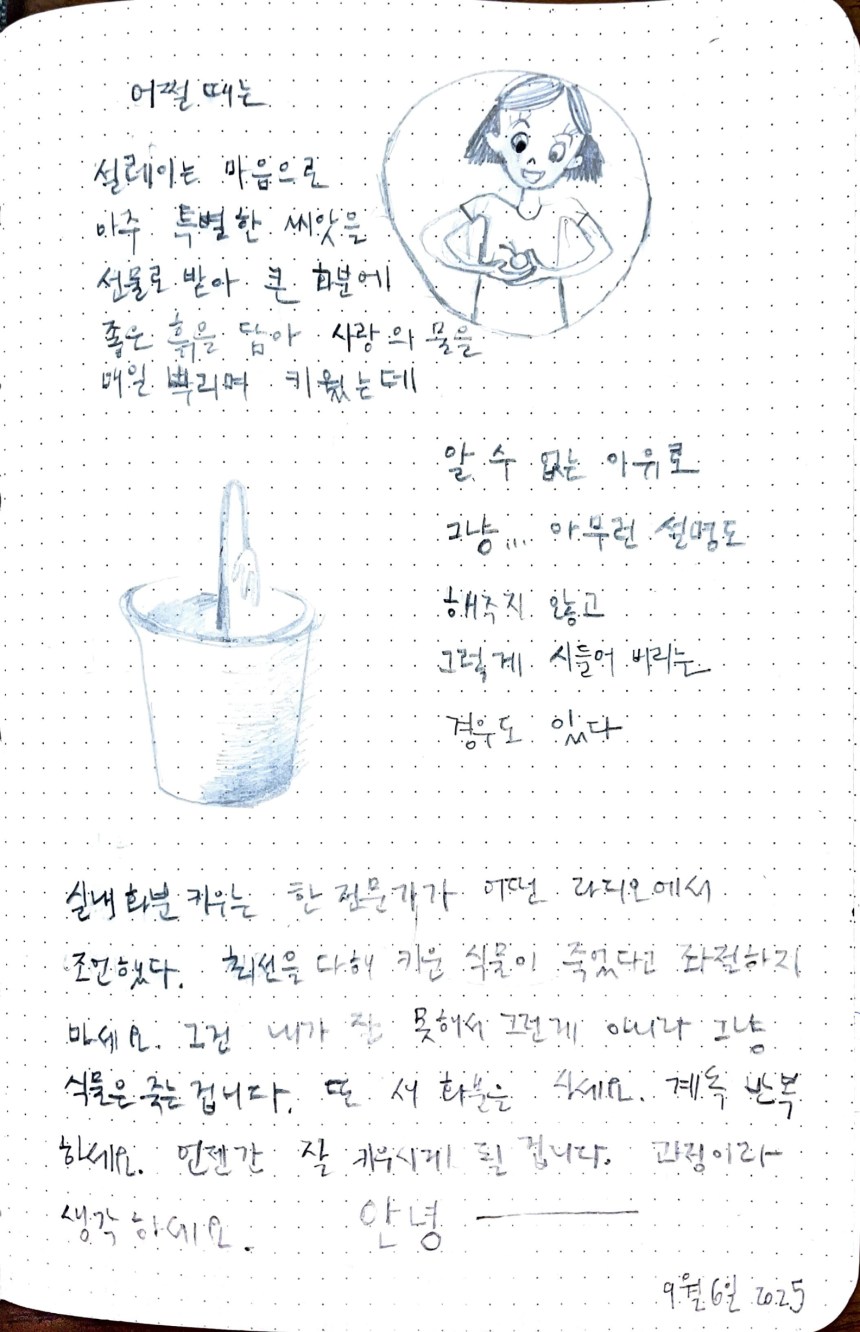
어떨 때는

In certin cases

A seed came as a gift and I planted it with much delight–oh, how lucky I am that this seed found me–in a large clay pot filled with the best kind of compost and measured the moisture amount of the soil each day with the tip of my finger.

Despite such effort, for an unknown reason, without giving any explanation, there are cases in which all comes to a sudden end.

Advice from an indoor plant expert that I heard on the radio says, “Don’t be so disappointed and don’t say so easily that you are not good at raising plants. It’s not because you did something wrong. In certain cases, plants just die. Buy a new plant. Repeat it again and again, and for certain, you will have some plants that flourish.”

Bye, my special plant. 너가 있어서 웃을 수 있었어.

Daily Inspirations

Tree Planted by Streams of Water

Some of you know I am starting a new and very unexpected chapter of my life. I find myself as a seminary student at Princeton Theological Seminary. Today, we had our first chapel service.

We reflected on Psalm 1, what used to be my favorite poem during my undergraduate days. “Blessed are those who delights in the Spirit of Love, and in Love’s heart they dwell day and night.”1

They are like a tree planted by streams of water.

President Wilson’s powerful meditation on this piece of poetry transferred a strong image of a tree that has solid and healthy roots and is reaching out wide and tall. This is so powerful that it makes my heart swell.

I made a woodcut print titled “…A Tree Planted by Streams of Water,” in 2000. There, I wanted to portray the vigorous living energy of a healthy tree carried through moving shapes, color, and carved strokes. I rarely use primary colors now, and it is so refreshing to see my younger self being excited about pure colors.

Being Rooted. This carries a lot of emotional weight for me at this point in my life when I am far from rooted in a practical sense. (Could you please stop asking the question, where do you consider home now? I get seriously embarrassed with this question.)

But being rooted in something other than the practical. How about relational? I have friends and family in different continents, in whom we find rootedness. And I have my faith tradition, like prayer, ancient texts about God that are like water and minerals feeding my roots. And a couple of real trees in Princeton that are so big-hearted that they never discriminate in their welcoming. (This is material for another future entry)

Where am I reading to? Towards other fellow earthlings who need some serious healing like me, and more-than-human creatures who are waiting for me to bond with them.

We are alike a tree that’s planted by the water, we shall not be moved.

  1. Nan C. Merrill, Psalms for Praying: An invication to Wholeness, Psalm 1 ↩︎
KimyiBo Art

Digging up the traces of my work in the past

As I am preparing for an artist talk, I found these precious traces of my past work the web.

Blessings I at Highpoint center for printmaking, 2012

Blessing II at Augsburg College, 2012

À table, artistes résidents et invités de l’atelier genevois de gravure contemporain, 2018

KimyiBo Art

인연 Inyeon

I am preparing for 100 Bottles of Peace at Nassau Presbyterian Church. I met a videographer who will be filming the workshop for the first time. I was talking to him about the places I have lived before and find out the he too lived in Minneapolis while he was studying at the same university my husband studied at. The years when we were in the same city didn’t match. He was there a few years after we left. Then he asked where did you live? And he told me his old address. Somehow the numbers sounded awfully familiar. So I searcher in my email for my old address which I never had to recall for the past ten plus years. And the same street number came up as my address in Minneapolis. So it turns out that we lived in the apartments across from each other in the same hall way. Actually I think a neighbor turned friend with whom I now lost contact was living in that unit. Her low and strong voice calling her two children is still fresh in my ears.

100 Bottles of Peace was a project that was conceived in Minneapolis in my first art studio. The studio was in an building with a couple of other artsits’ studios and we participated in a community open studio. For this event, I had a strong urge to do a participatory art project. So I decided to collect people’s reflections on peace in my drawings of a bottle.

After the event, I went to different groups and collected more peace. Some people mailed in their peace. What I have gathered, I showed as a slideshow during my first solo exhibition in Minneapolis in 2010.

Time has passed. When I look at my pictures from that time, I look so young. My face features changed. After saying bye to the videographer, I came back to my studio in Princeton. In the lobby there were some free pastries. With a hungry stomach I was picking up a cinnamon twirly danish. Then someone calls my name so loudly, “Bo!”

I said to myself, who would know me here? And I turned and I couldn’t believe whom I was looking at. He was a dear friend from Minneapolis. I have not seen him since we left the city and I rarely communicated with him through emails or social media. Wow… How he grew up. He was in high school when we were in Minneapolis.

He showed me a picture of his seven year old daughter. She is so lively. He said I remember you were always cooking and painting. And here you are, still making art! He looked at my drawings on the wall, and pointed at one. We talked about what art is. How art makes you feel something. How artist can make someone feel what she is feeling…

Isn’t life good? Doesn’t life sometimes give you such a nice surprise?

And how are we supposed to respond to that?

KimyiBo Art

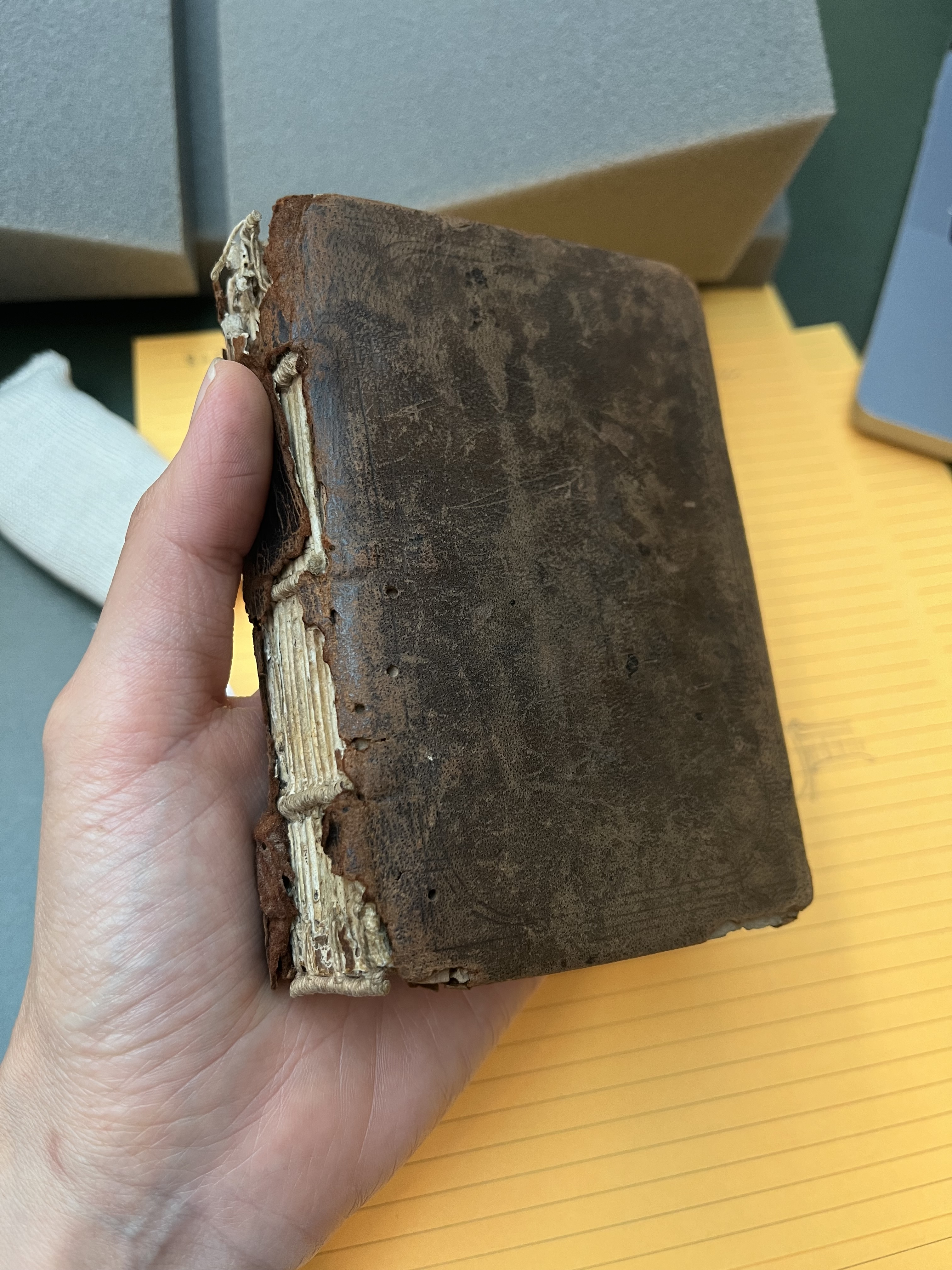
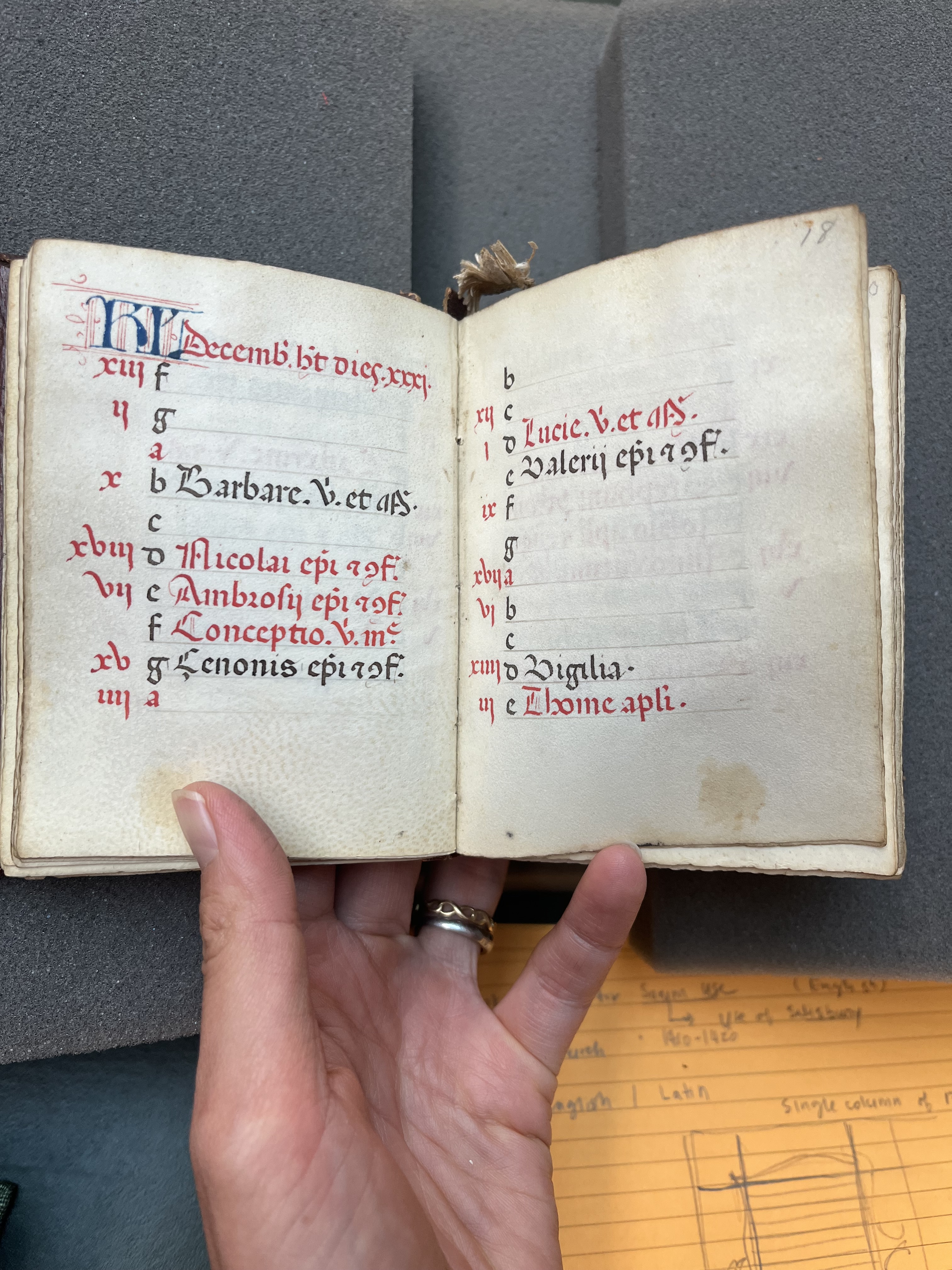
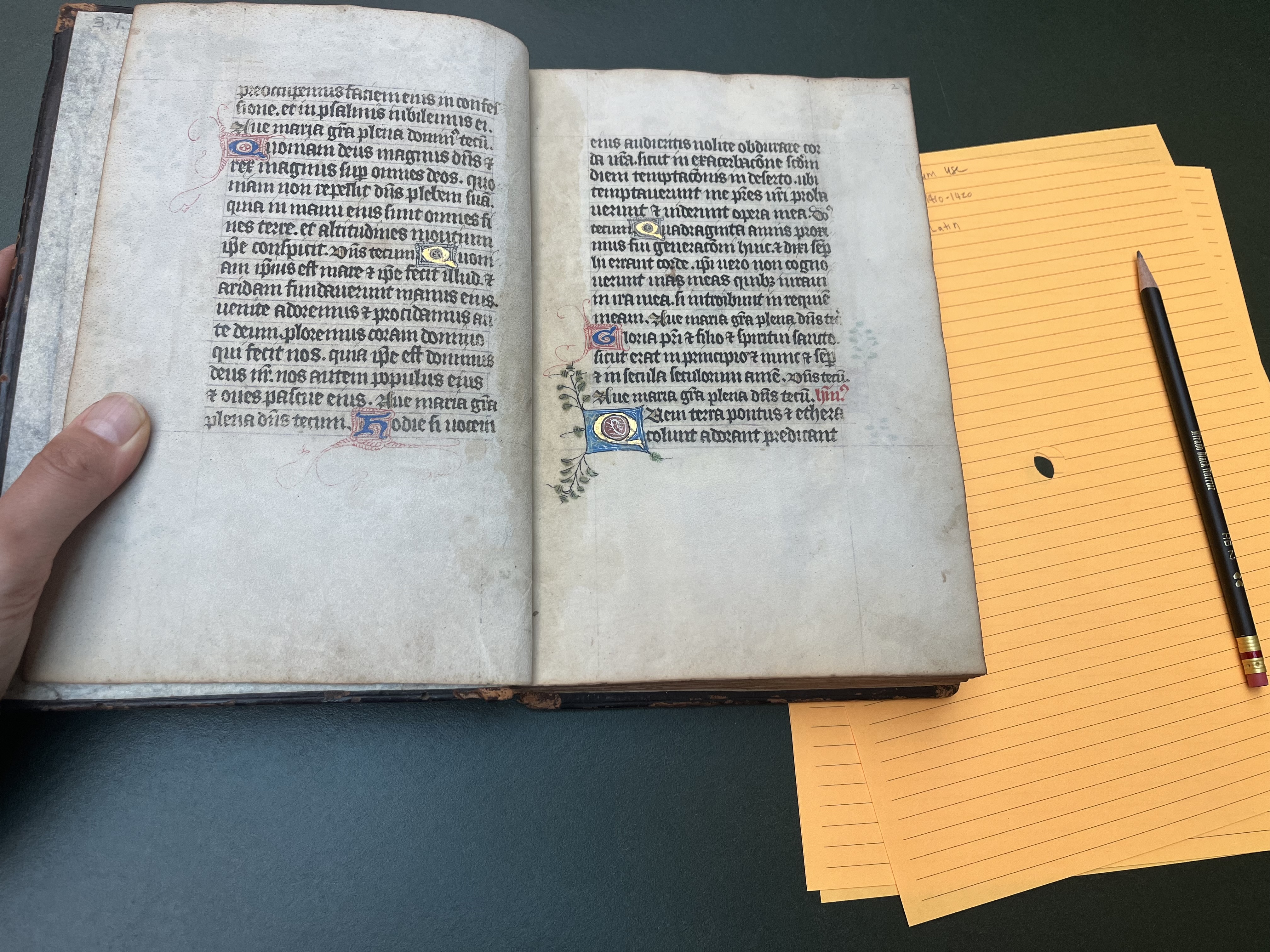
Meeting Book of Hours face to face

September 25, 2024

Most of you may not have seen my undergraduate thesis show at Penn in 2003. I just typed 2023 and erased it… It’s hard to believe it was more than twenty years ago. 

I made a series of six painting/collage on wood panel for this exhibition and called it “Book of Hours.”

The images showed the spaces where I moved about throughout the day. It starts with a “book cover” and moves on the second image with an oval, like the window of an airplane. The third and fourth images contain parts of the Fisher art library. This is the space I adored the most during my stay at Penn.  Fifth one was one of the drawing classrooms at Charles Adam building and the last image is from my bedroom in a shared apartment in west Philadelphia. 

I don’t know when I first fell in love with books of hours, probably during one of the art history classes.  I think anyone who comes across any reproductions of the  illuminations from Très Riches Heures of Jean, Duc de Berry by Limbourg brothers would find it hard not to fall under its spell. 

The Liberians and conservators in Europe and the US have digitalized many of them and people can find these images easily on the web. 

I would search up these images once in a while, when I missed them.

And for the first time I am holding one in my hand. 

At a special collection library in Princeton, I have a privilege of smelling the pages, looking at chipped paint flakes and feel the gold leaf on parchment with bare finger.

I am so grateful.

KimyiBo Art

Seven ways of looking at my art

Seven Ways of Looking at My Art, Written after an exhibition Perpetual Tension held in Fallout Urban Art Center in Minneapolis in 2010.

  1. Perpetual tension: From MFA onwards, my research and work focus on the relationship between people and nature; the “perpetual tension” between the two. Yes, perhaps this preoccupation is a bit typical, especially coming from an Asian. Typical themes are typical because they have elements of the classical, however, and my works are the classical inquiry into the meaning of our existence relative to our environment.
  • Perpetual tension in my life: Living local in the globalized society. Reflecting on my transnational lifestyle, I devised the concept of “contactism.” Based on the assumptions of humanistic psychology (Carl Rogers) that views the human organism to be ever seeking self-actualization using the most of her given environment, the concept explains how a person’s psychological architecture is strongly influenced by the number and degree of significant “contacts” she has with various cultures (including societal incentive structures and individuals) throughout her life. The resulting attitude towards life validates two conflicting desires: the youthful aspiration to self-actualize in multiple places, and the strong motivation to stay in one place and invest in a local community, like a tree taking root. My art is a medium through which I live out contactism. I decided that wherever I move I will fully engage in the local community and serve as an artist. Holding exhibitions, painting murals, teaching, organizing art related activities at my current location allow me to connect with people and environments that become part of who in the long run. 
  • Living energy in my work: An understanding of Ki permeates all of my artistic expressions. Parallel to my painting and printmaking works, I have been practicing calligraphy for the past ten years. The essence of calligraphy is capturing one’s Ki; energy, life. In this tradition, the stroke is in itself simultaneously the form and the concept of the art. This philosophy influenced my understanding of how art is connected to nature, and is carried through my painting and print works. I aim to create artworks that are alive.[1]
  • Contentious homeostasis: Visually, my images are metaphors of contentious homeostasis. The balance oscillates between geometric and organic forms; flat surface and pictorial space; two opposing forces. The picture plane is imbued with tension.
  • Symbols: I draw mundane objects repeatedly; fruits and vegetables, trees, clouds, and kitchenware. In each consecutive piece, I change a few elements from the previous drawing until the object becomes a playful shape. These shapes have an emotional quality I identify with. They are the symbol of living energy. 
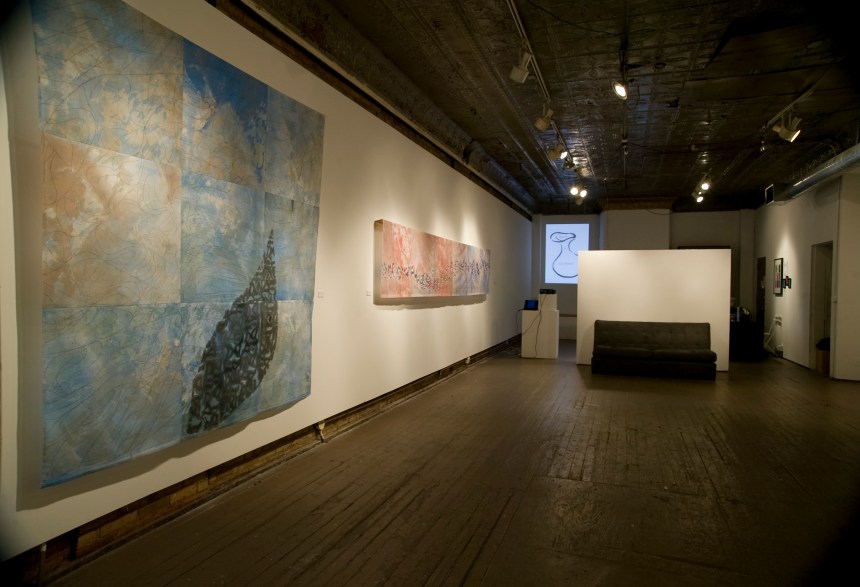
  • Patterns: I make patterns with symbols. I morph uniform patterns, which appear flat on the surface, so that they would seem to be extending in pictorial space. In other words I apply perspective to patterns. The resulting ambiguous space is neither completely flat nor deep, but it is either/or both. In my most recent solo exhibition Perpetual Tension (2010), I created large-scale wall hanging pieces using silkscreen and drawing on linen. By exhibiting a sheet of cloth a few inches off the wall, the physical flatness of the picture plane was accentuated. 
  • Process: I value the process of art making. My art goes against ever increasing entropy, restoring balance to areas that are difficult to do so: personal lives that are characterized more by distractions than peace and the attitude that puts people above nature than within it.

Written in 2010 in Minneapolis


[1] In the context Western narrative of art, “living artwork” is not easily understood. The closest concept is Elan Vital, which was a term coined by Henri Bergson(1859-1941.) The term was also used in a title of a book that presented works of Kandinsky, Klee, Arp, Miro, Calder [Hubertus Gaßner, Elan vital, or the Eye of Eros: Kandinsky, Klee, Arp, Miro, Calder, (Munich: Haus der Kunst: 1994.]

My Homeland Fieldnotes

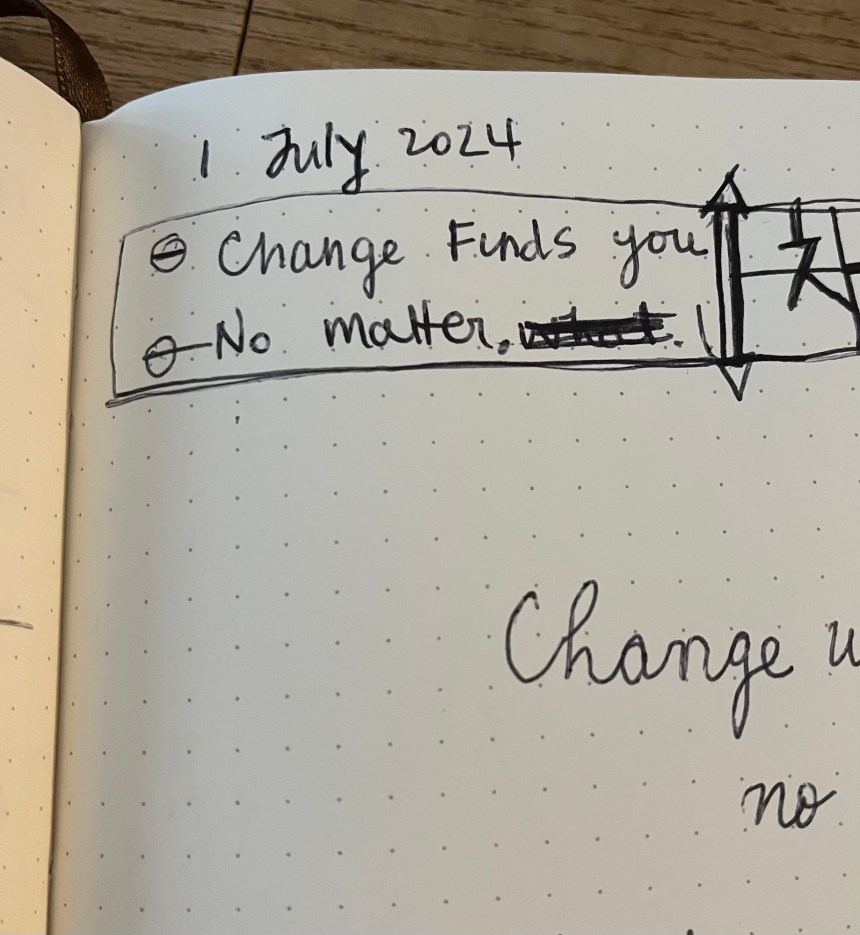
Change finds you

always.

a friend quoted a nonagenarian:

“Nobody will change

unless it becomes harder to stay.”

I would add

the more you resist change

more stealthy she will become

to sneak into your house.

Change found me again, but no matter.

(playing around with the opening line of Pachinko by Min Jin Lee)

My Homeland Fieldnotes

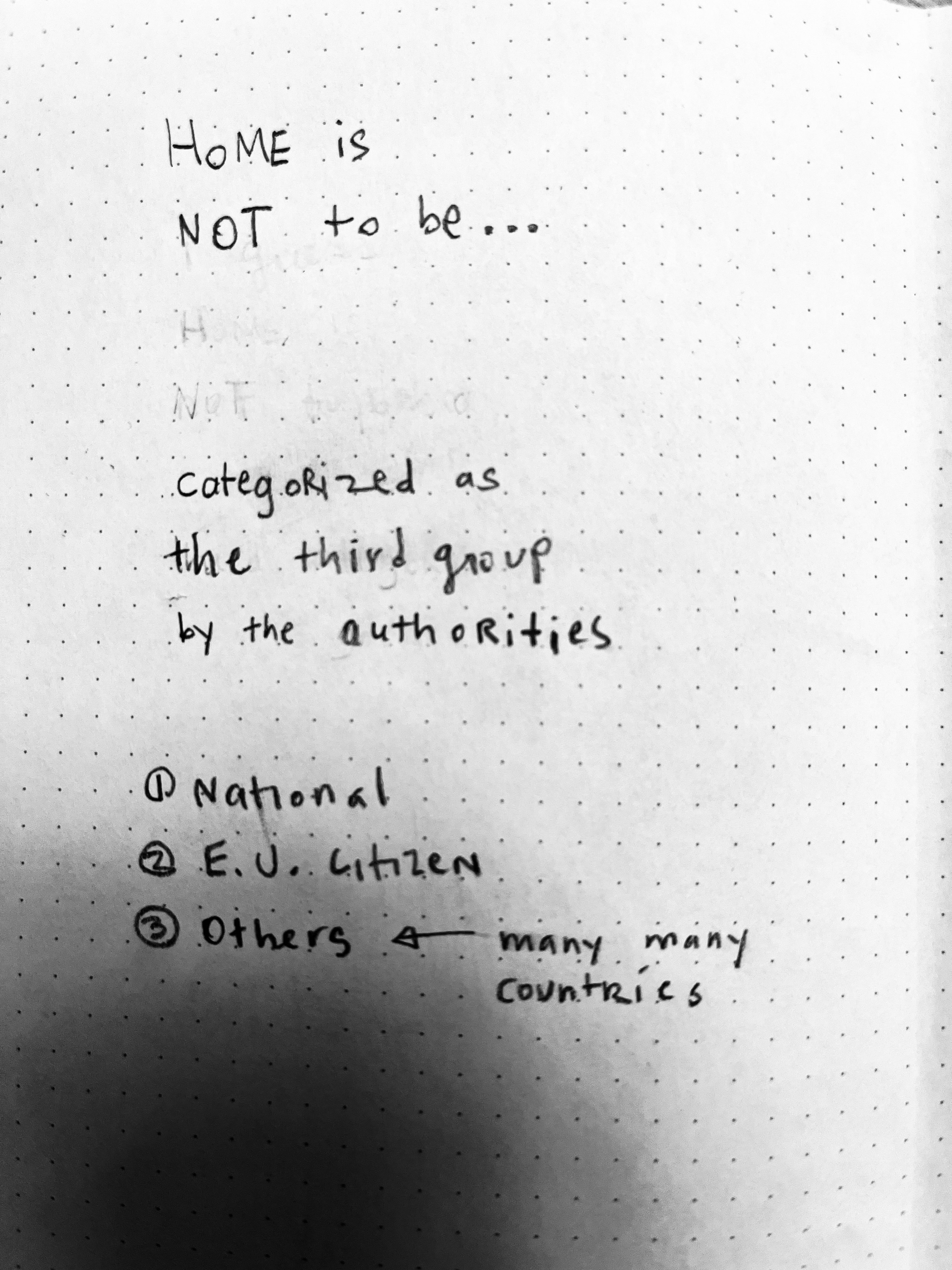
Nine years of living in Europe

By learning what home is not I am getting one step closer to home.